The Initiation of Intravenous Hydrogen Nano Bubble Injection and Its Phase 3 Clinical Trials for Parkinsonism Patients, as well as Its Future Benefits
14:43, 03 February 2025 by admin
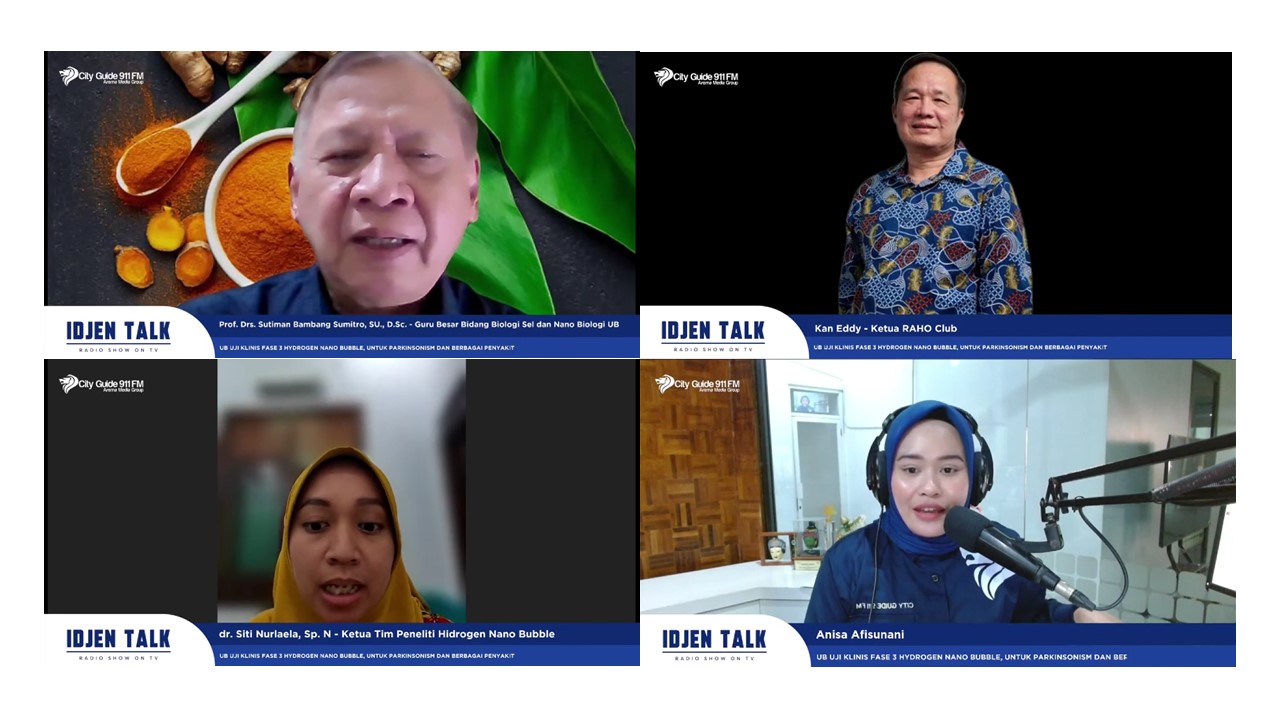
Malang, January 22, 2025 – The research on complementary therapy for individuals with parkinsonism using Intravenous Injection of Nano Hydrogen Bubbles, has entered phase 3 clinical trials at Universitas Brawijaya Hospital (RSUB). This research is a collaboration between the Indonesian Molecular Institute (IMI) and RSUB, with the support of the RAHO Club as the sponsor. It is hoped that in the future, this Nano Hydrogen Bubble Intravenous Injection can treat various symptoms and improve the quality of life of people with parkinsonism. The evaluation of the phase 3 clinical trial implementation was discussed in a radio interview on City Guide 911 FM, during the Idjen Talk program. The discussion was attended online by three speakers: Prof. Drs. Sutiman Bambang Sumitro, SU., D.Sc., dr. Siti Nurlaela, Sp.N, and Mr. Kan Eddy.
Let's first understand the technology behind hydrogen nano bubbles and how they work. Essentially, hydrogen is a gas that forms bubbles when in water. "Nano" refers to the small size of these bubbles, with 1 nanometer being extremely tiny and invisible to the naked eye. The hydrogen nano bubbles used in this research measure between 80-100 nanometers, which will be dissolved together with oxygen. Prof. Sutiman B Sumitro a Professor of Cell Biology and Nano Biology at Universitas Brawijaya and an advisor the Indonesian Molecular Institute (IMI), stated that the idea of this research originated during the COVID - 19 pandemic. Many patients experienced breathing difficulties and required oxygen tanks. The main issue was that, despite the availability of oxygen, inhaled oxygen struggled to reach the lungs effectively. This led to the idea of delivering oxygen into the body without relying on the respiratory system—by using nano bubbles. However, using oxygen alone proved less effective, so it had to be combined with hydrogen in a 1:2 ratio. Hydrogen plays a role as an antioxidant in the body. The mechanism or working principle of this approach is to deliver hydrogen and oxygen into the body’s system without relying on hemoglobin or red blood cells. Because of their small size, these molecules can easily enter the cells.
Initially, research on hydrogen nano bubbles began with an in silico approach, using computer simulations. It then progressed to animal testing (preclinical trials) and now has entered phase 3 clinical trials. Basically, this research is also carried out in many research places with various types of diseases. The head of the hydrogen nano bubble research team at RSUB, dr. Siti Nurlaela, Sp.N. explained that, “The research at RSUB focuses on parkinsonism”. This disease is a neurological disorder, characterized by tremor or frequent shaking, rigidity or muscle stiffness, akinesia (loss of ability to move muscles) and postural instability which causes people with parkinsonism to fall frequently. The phase 3 clinical trial is targeted at patients under 70 years old who have been clinically diagnosed with parkinsonism. In her interview, dr. Siti Nurlaela, Sp.N., stated that a total of 35 participants would receive intravenous injections of hydrogen nano bubbles. Initial evaluation of the first group, consisting of six patients who completed 12 therapy sessions (administered once or twice a week at a dose of 20 cc), showed promising results. The degree of parkinsonism improved—patients who previously had difficulty sitting and standing independently showed progress. Cognitive function, assessed using the Montreal Cognitive Assessment-Indonesian Version (MoCA-INA), which detects cognitive impairment in Parkinson’s patients, also showed improvement. Additionally, the patients’ quality of life, measured using the Parkinson’s Disease Questionnaire 39 (PDQ-39), demonstrated positive changes.
In a radio interview on City Guide 911 FM, the Chairman of Raho Club, Mr. Kan Eddy—who was also the first participant to receive intravenous hydrogen nano bubble injections—shared his experience after undergoing the therapy. At that time, Mr. Kan Eddy had suffered from Transient Ischemic Attack (TIA), a type of stroke that comes and goes. Over the course of a month, he experienced up to 20 attacks. Due to the COVID-19 pandemic, he faced difficulties accessing hospital treatment. Eventually, he met Prof. Sutiman, who offered him the opportunity to undergo hydrogen nano bubble therapy. Prof. Sutiman had previously explained that preclinical trials showed hydrogen nano bubble therapy to be safe and free of side effects. Encouraged by this, Mr. Kan Eddy decided to try the therapy and became the first patient to receive it. He reported that by the third therapy, his bodily functions had returned to normal, allowing him to resume daily activities. After the fifth infusion, an MRI scan at Brain Clinic, Surabaya, revealed that the blockage in his brain had disappeared. In what seemed like a miraculous recovery, Mr. Kan Eddy was cured of his stroke after just five therapy sessions. Over the past four years, he has undergone 165 therapy sessions, and he feels that his body's performance has significantly improved—making him feel younger than his actual age. Now 57 years old, he claims his physical condition is similar to that of a 40-year-old, with no side effects and continuous improvement in bodily functions. This remarkable recovery was also experienced by his mother, who had severe parkinsonism. She had been bedridden for 1.5 years, but after her eighth therapy session, she was able to start walking again. Today, she can live normally, and her tremors have significantly decreased
Based on Mr. Kan Eddy’s explanation, intravenous hydrogen nano bubble injections have shown numerous benefits in improving the body’s overall function. However, this must be accompanied by a healthy lifestyle. dr. Siti Nurlaela emphasized that patients with parkinsonism who have received hydrogen nano bubble injections and shown improvements are advised to maintain their health. This requires paying close attention to lifestyle factors, including proper nutrition and a well-balanced diet, as well as regular exercise. Without a healthy lifestyle, even after successful therapy, the body’s condition could deteriorate again. The lead researcher stated that the phase 3 clinical trial of intravenous hydrogen nano bubble injections began in October 2024, with the first session consisting of six patients who completed their infusions in November. Following their improvements, the research team has continued monitoring their condition, and so far, no signs of deterioration have been observed. This indicates that the benefits of hydrogen nano bubbles have remained effective over time. However, patients who experience improvement and feel more comfortable are strongly encouraged to maintain a healthy lifestyle by consuming balanced nutrition and engaging in regular physical activity to sustain their well-being.
In the interview, Prof. Sutiman expressed his hopes, stating, "With the intravenous hydrogen nano bubble injection, we can address the health challenges faced by Indonesian society. Currently, the average lifespan in Indonesia is 71.6 years." This means Indonesia is facing an aging population issue, where it is rare to see elderly individuals above 71 years old who remain active. In fact, data from the Badan Pusat Statistik (BPS) indicates that many Indonesians aged 60 and above have low productivity levels, making them dependent on their family members. This issue needs to be addressed because if the physical and mental conditions of the elderly can be improved, it could increase national productivity and positively impact Indonesia's economy. Additionally, most elderly individuals suffer from multiple chronic diseases, such as diabetes and hypertension, which is a significant concern that requires an affordable and accessible solution. Prof. Sutiman likened this to the English idiom "Killing two birds with one stone," meaning solving multiple problems with a single action—through intravenous hydrogen nano bubble injections. His hope is that this therapy can contribute to improving the health of the Indonesian population, especially elderly individuals and those suffering from parkinsonism.
News sources:
https://www.youtube.com/watch?v=uVoVuK-k0TI&t=520s (Idjen Talk - UB Uji Klinis Fase 3 Nano Bubble Untuk Penyakit Parkinsonisme dan Berbagai Penyakit)