
Why Oxygen and Hydrogen Are Better Given in the Form of Nanobubbles?
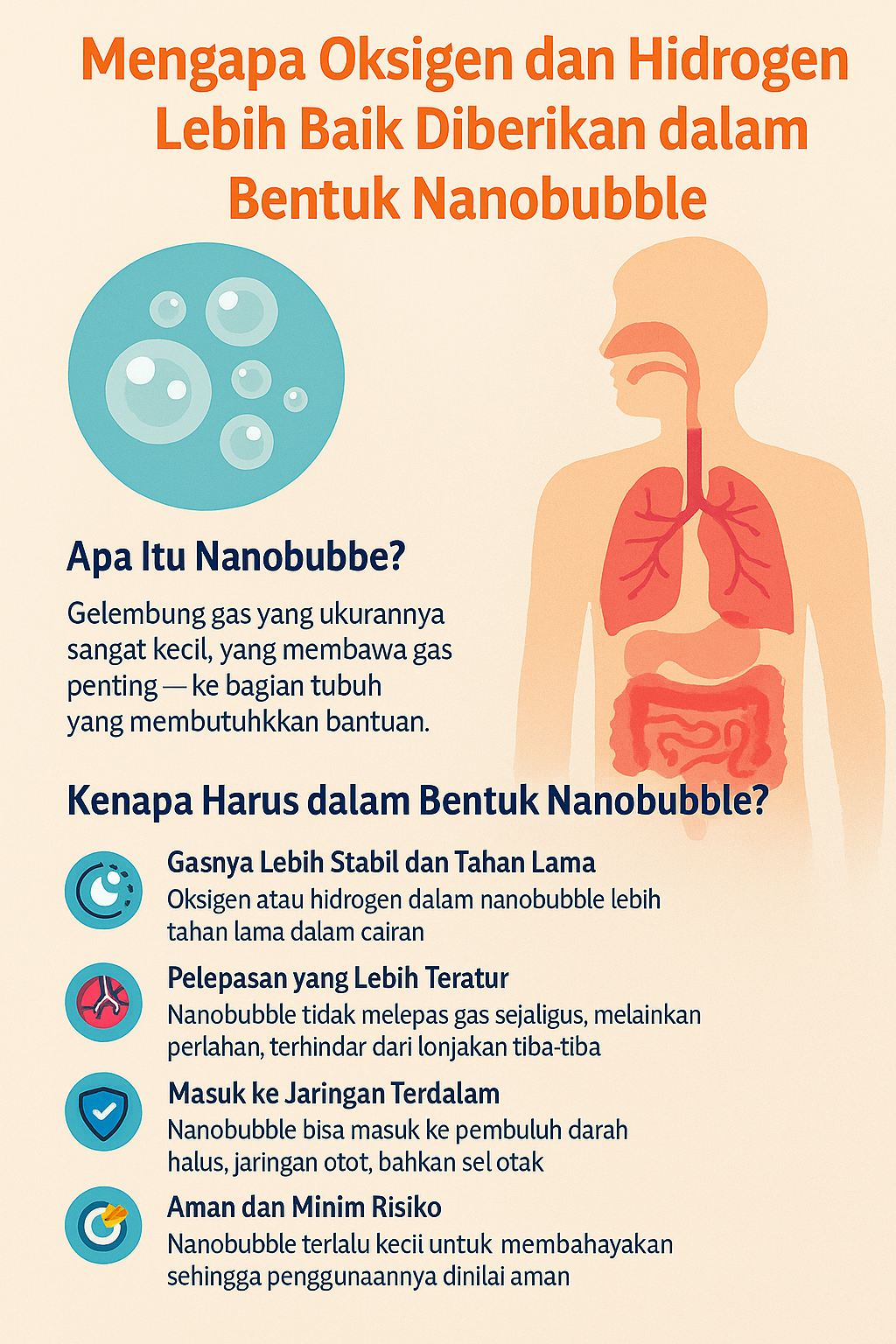
In recent years, scientists and healthcare professionals have increasingly studied and used nanobubbles—tiny gas bubbles—to deliver essential gases like oxygen (O₂) and hydrogen (H₂) into the body. Both of these gases provide significant health benefits. But it turns out that it's not just the type of gas that matters; the way the gas is delivered into the body also greatly affects its effectiveness. If administered incorrectly or inefficiently, the body may not absorb it optimally.
That’s why nanobubbles are becoming a promising solution. Compared to older methods like gas inhalation therapy, nanobubbles are far more efficient, safe, and stable. They can carry gas directly to the parts of the body that need it, absorb better, and release gas slowly in sync with the cells’ needs. This technology is now seen as a breakthrough in modern medicine and holds great potential for various therapeutic applications.
Nanobubbles are extremely tiny gas bubbles—hundreds of times smaller than a red blood cell. Due to their tiny size—less than 200 nanometers—they have unique properties. Nanobubbles can remain stable in liquids for a long time, are not easily broken like regular bubbles, and are able to penetrate the body’s microcirculation, which includes small blood vessels and tissues that are difficult to reach using standard drugs or gases.
You can think of nanobubbles like tiny delivery vehicles carrying beneficial gases—such as oxygen and hydrogen—directly to parts of the body that need repair or healing. Oxygen is essential for producing the energy needed by the brain, muscles, and other vital organs. Hydrogen, on the other hand, acts like a “cell guardian” because of its remarkable ability to neutralize harmful substances (free radicals) and reduce inflammation in the body.
Why Should It Be in the Form of Nanobubbles?
One of the main reasons oxygen and hydrogen work better in nanobubble form is because they are more stable and last longer in body fluids. When given directly as regular gas, oxygen or hydrogen quickly evaporates or dissipates before the body can absorb them efficiently. But when packaged in nanobubbles, the gases can stay longer and be gradually absorbed according to the cells' needs—making the therapy more effective and long-lasting.
Additionally, nanobubbles have the advantage of controlled and gradual gas release. Instead of releasing gas all at once, they do so slowly and steadily, avoiding sudden surges that could be harmful. For example, a sudden spike of oxygen in the body can cause oxidative stress and damage cells. Nanobubbles allow this process to be regulated safely and effectively. Thanks to their tiny size, they can also reach delicate areas like small blood vessels, muscle tissues, and even brain cells—delivering the therapeutic gases exactly where they’re needed.
Another advantage lies in their safety and additional healing benefits. Unlike large gas bubbles, which may pose risks like gas embolism (blockage in blood vessels), nanobubbles are far too small to cause such problems. That’s why their use through infusion or even therapeutic drinking water is considered very safe. What’s even more exciting is that research shows nanobubbles—especially those containing hydrogen—can help the body’s natural healing processes. This includes reducing inflammation, protecting cells from damage, and promoting tissue regeneration. So nanobubbles aren’t just safe; they also actively support the body’s recovery from the inside out.
Reference
Ohta, S. (2014). Molecular hydrogen as a preventive and therapeutic medical gas: initiation, development and potential of hydrogen medicine. Pharmacology & Therapeutics, 144(1), 1–11. https://doi.org/10.1016/j.pharmthera.2014.04.006
Aoki K, Ida Y, Fukushima N, Matsumura H. Topical application of oxygen nano-bubble water enhances the healing process of ischaemic skin wound healing in an animal model. Int Wound J. 2022 Nov;19(7):1843-1852. doi: 10.1111/iwj.13790. Epub 2022 Apr 10. PMID: 35403362; PMCID: PMC9615287. https://pubmed.ncbi.nlm.nih.gov/35403362/
Zhou, Y., et al. (2023). Nanotechnology's frontier in combating infectious and inflammatory diseases. Signal Transduction and Targeted Therapy, 8, 45. https://doi.org/10.1038/s41392-024-01745-z