
Understanding Nanobubble Gasotransmitters: A New Way to Deliver Molecular Signals to Cells
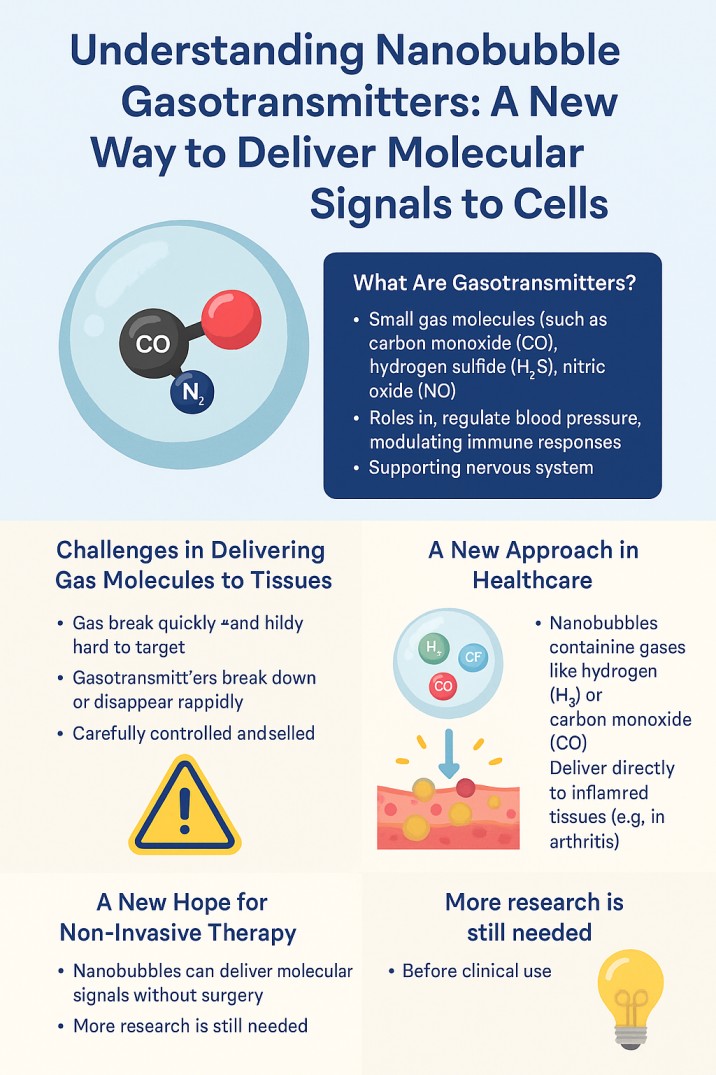
Some types of gas in the body do more than just support breathing or serve as byproducts of metabolism—they also act as "messengers" between cells. Small gas molecules such as carbon monoxide (CO), hydrogen sulfide (H₂S), and nitric oxide (NO) are known as gasotransmitters. These tiny molecules help cells communicate with each other. While they can be toxic in high concentrations, in very small amounts they play important roles in regulating blood pressure, modulating immune responses, and supporting nervous system function. Even oxygen (O₂), essential for life, acts as a biological signal when its levels drop. More recently, hydrogen gas (H₂) has also gained attention for its potential antioxidant and anti-inflammatory effects that may support cellular health.
Challenges in Delivering Gas Molecules to Tissues
Despite their potential, using gasotransmitters for therapy is not easy. Gas molecules tend to spread quickly and are hard to direct to specific organs. Their volatile nature means that gases like NO and H₂S may break down or disappear before reaching their target. Additionally, gasotransmitters are highly reactive and short-lived in the body, so their effects may not last long. Getting the dose right is also tricky: too little may have no effect, but too much could harm healthy cells. That's why controlled, sustained, and targeted delivery methods are essential to safely and effectively use these gases in treatment.
Nanobubbles containing gases such as hydrogen, oxygen, or other gasotransmitters are now being explored as a new approach in healthcare. In cases of inflammation, for example, small amounts of hydrogen (H₂) or carbon monoxide (CO) are known to help calm excessive immune responses. With nanobubbles, these gases can be delivered directly to inflamed tissues—such as in arthritis or muscle injury—helping reduce swelling without disturbing the body’s overall balance. In the field of neurology, gases like hydrogen sulfide (H₂S) and hydrogen also show potential in protecting nerve cells. Early studies report that nanobubble infusions may support stroke recovery, reduce muscle spasms, and improve mobility—all with minimal side effects.
A New Hope for Non-Invasive Therapy
Nanobubble gasotransmitters represent a promising innovation that could change how we approach treatment in modern medicine. Their ability to deliver signaling molecules precisely to their target without the need for surgery opens up new pathways for minimally invasive molecular therapy. As with any emerging technology, more research and clinical trials are still needed to confirm their safety and effectiveness before they can be widely used. Even so, this method offers a glimpse into the future—where diseases might be treated using microscopic gas bubbles that deliver therapy gently and efficiently throughout the body.
Sources:
-
Xu, Y., Li, Y., Gao, A., Chu, P. K., & Wang, H. (2023). Gasotransmitter delivery for bone diseases and regeneration. The Innovation Life, 1(1), 100015. https://doi.org/10.59717/j.xinn-life.2023.100015
-
Panthi, S., Manandhar, S. & Gautam, K. Hydrogen sulfide, nitric oxide, and neurodegenerative disorders. Transl Neurodegener 7, 3 (2018). https://doi.org/10.1186/s40035-018-0108-x