
Tiny Tech vs. Toxic Tornado: How Nanobubbles, Genes, and Cells Could Rewrite the Future of Steven Johnson Syndrome
By: dr. Dito Anurogo, M.Sc., Ph.D.
The human body can be likened to an organized system where organs work together to maintain health. Every cell has an important role, and the immune system serves as the body's main defense against various threats. However, sometimes the immune system can make mistakes—attacking the body itself instead of protecting it. This is what happens in Stevens-Johnson Syndrome (SJS), a severe allergic reaction usually triggered by certain medications. In this condition, the immune system mistakenly identifies the drug as a dangerous threat and attacks the skin and mucous membranes. As a result, the skin can blister, peel off, and severe inflammation occurs, which can be life-threatening.
To date, the treatment of SJS remains symptomatic, focusing on caring for wounds and reducing inflammation after the reaction occurs. There is still no definitive way to prevent this reaction before it happens. However, researchers in various laboratories are now developing new hope through nanotechnology, smart cell therapy, and genetic engineering. The goal is not only to treat the symptoms but also to prevent the immune system’s overreaction from the very beginning, helping patients avoid the dangerous consequences of SJS.
Nanobubbles: Tiny Bubbles Offering New Hope
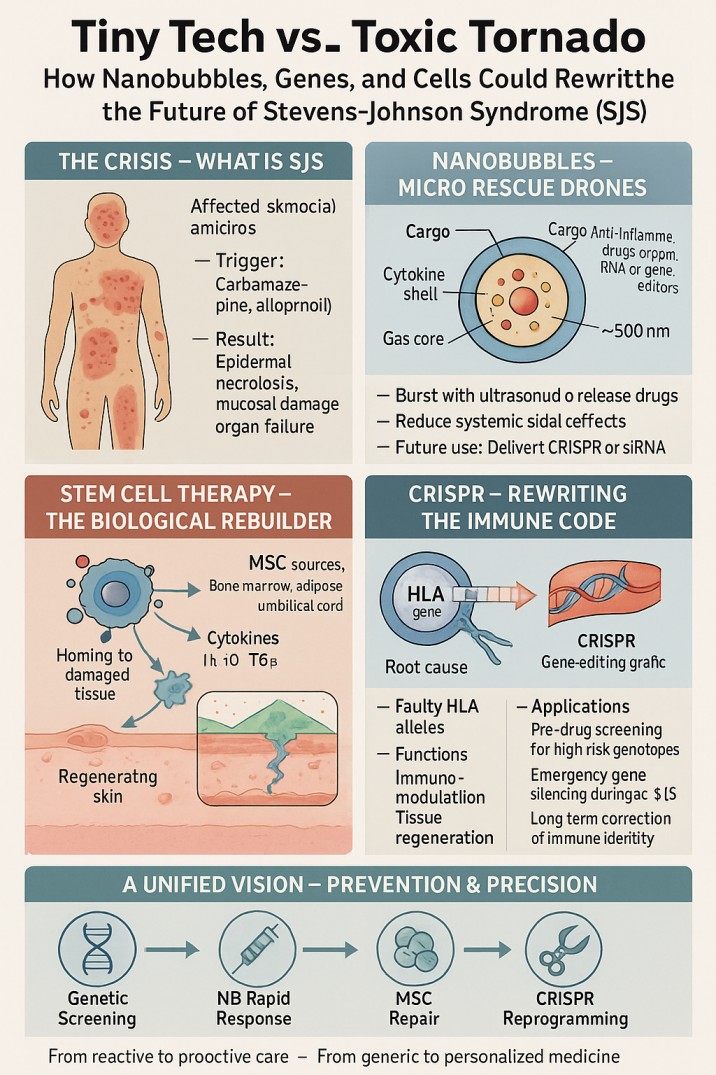
Nanobubbles (NBs) are microscopic gas bubbles, thousands of times smaller than a single strand of human hair. Thanks to their tiny size, these bubbles can carry important therapeutic substances that help the healing process in the body. In cases like Stevens-Johnson Syndrome (SJS), where the immune system overreacts and causes severe damage to the skin and mucous membranes, nanobubbles can be used to deliver anti-inflammatory drugs more precisely. With this technology, medications can be encapsulated inside nanobubbles and directed straight to the affected area. Once there, the therapeutic substances can be released using gentle ultrasound waves, ensuring the medicine works exactly where it's needed without damaging healthy tissues around it.
Beyond delivering medication, nanobubbles can also carry oxygen to damaged skin areas, helping tissues that are lacking oxygen to heal more effectively. In the future, researchers are working to develop nanobubbles capable of delivering gene therapy, such as RNA fragments or gene-editing tools, to control excessive immune reactions. This technology presents a new vision for medicine: smart, targeted interventions with minimal side effects, making treatments more effective and safer for patients.
The Role of Mesenchymal Stem Cells: Controlling Inflammation and Accelerating Healing
When the skin suffers severe damage, as in Stevens-Johnson Syndrome (SJS), the body needs more than just medication to fight inflammation—it also requires help to repair the damaged tissues. This is where Mesenchymal Stem Cells (MSC) come in.
MSC are adult stem cells that can be harvested from tissues such as fat, bone marrow, or umbilical cords. These versatile cells can reduce inflammation, accelerate healing, and help repair damaged tissues. MSC work by following chemical signals from areas of injury or inflammation. Upon arrival, MSC release anti-inflammatory substances like IL-10 and TGF-β, which help calm down the immune response so that it doesn’t continue to harm the body. At the same time, MSC produce growth factors like VEGF and EGF, which support the growth and repair of skin and surrounding tissues.
In severe cases of SJS where skin damage is extensive, MSC can even be used to create artificial skin layers that are directly applied to wounds. This therapy not only repairs damaged tissues but also helps prevent serious complications such as blindness or narrowing of the urinary tract, which can arise from severe tissue damage. With this potential, MSC serve not only as a short-term healing therapy but also as a way to reduce reliance on long-term immunosuppressive drugs and help restore immune balance.
CRISPR-Cas9: Gene Editing Tools to Change the Course of Disease
Why do some people experience severe allergic reactions, such as Stevens-Johnson Syndrome (SJS), when taking medications that are safe for most others? The answer often lies in the HLA (Human Leukocyte Antigen) genes, which are part of the immune system responsible for recognizing threats. In some individuals, genetic variants such as HLA-B*15:02 can cause the immune system to overreact to drugs like carbamazepine or allopurinol, triggering harmful reactions.This is where the CRISPR-Cas9 technology plays a role. CRISPR is a tool that allows for precise gene editing, similar to correcting a typo in a text but at the genetic level. In theory, with CRISPR, the problematic section of the HLA gene can be repaired in the patient's blood cells. These corrected cells can then help build an immune system that is more tolerant and less likely to overreact.
Currently, the more common application is genetic screening, which involves DNA testing to identify individuals at risk before prescribing certain medications. This allows for the prevention of severe reactions like SJS. In the future, CRISPR has the potential to go even further—not only preventing but also actively treating immune overreactions. The technology could be directed to switch off genes that trigger inflammation or enhance genes that protect the skin. These genetic therapies could be delivered using safe viruses or even via nanobubbles, enabling rapid and targeted treatment. Though still in development, gene-editing therapies like CRISPR bring new hope for preventing and managing severe drug allergies like SJS, not just in the lab, but also in real-world clinical settings.
Technologies for Reducing Genetic Risk: Moving Toward Smarter, More Targeted Medicine
Advances in medical technology are changing the way diseases are addressed, shifting from a focus on treatment after illness appears to a focus on prevention from the start. This new approach helps the body build a stronger defense system to face potential health threats.
One of the keys to this shift is genetic screening, which involves DNA testing to identify individuals who are at higher risk for certain conditions. With this information, preventive steps can be taken early, even before symptoms arise.
Additionally, nanobubbles offer a new way to deliver drugs or therapeutic substances directly to the areas of the body that need them. Thanks to their extremely small size, nanobubbles can reach precise targets, making treatments faster and more efficient. On the other hand, mesenchymal stem cells (MSC) play a key role in reducing inflammation and repairing damaged tissues, helping the body recover more effectively. Meanwhile, CRISPR technology brings the possibility of addressing the root cause of certain diseases by correcting genetic errors that trigger harmful reactions. Although still under development, CRISPR may one day be used to permanently prevent or treat disease at the genetic level.
The combination of these four innovations presents new hope, especially for patients with serious conditions like Stevens-Johnson Syndrome (SJS). This approach not only helps accelerate healing but also provides long-term protection to prevent similar diseases in the future. This is the future direction of medicine: moving toward smarter, more personalized, and more targeted treatments, all aimed at helping people achieve better health and quality of life.
References
- Hama, N., Aoki, S., Chen, C. B., Hasegawa, A., Ogawa, Y., Vocanson, M., ... & Abe, R. (2024). Recent progress of Stevens-Johnson syndrome/toxic epidermal necrolysis: Diagnosis criteria, pathogenesis and therapy. The British Journal of Dermatology. https://doi.org/10.1093/bjd/ljae321
- Kim, M. K., Yoon, K., Yoon, S. H., & Seo, K. Y. (2021). Clinical aspects of Stevens-Johnson syndrome and toxic epidermal necrolysis with severe ocular complications in South Korea. Frontiers in Medicine, 8. https://doi.org/10.3389/fmed.2021.640360
- Liotti, L., Caimmi, S., Bottau, P., Bernardini, R., Cardinale, F., Saretta, F., ... & Caffarelli, C. (2019). Clinical features, outcomes and treatment in children with drug induced Stevens-Johnson syndrome and toxic epidermal necrolysis. Acta Bio Medica, 90(3-S), 52–60. https://doi.org/10.23750/abm.v90i3-S.8165
- Thong, B. (2023). Drug-induced Stevens Johnson syndrome and toxic epidermal necrolysis: Interpreting the systematic reviews on immunomodulatory therapies. Asia Pacific Allergy, 13, 72–76. https://doi.org/10.5415/apallergy.0000000000000101
- Hao, H., Wang, W., Ran, X. M., Li, M. Q., Liu, B. C., & Wang, K. J. (2025). Immunorelated Stevens-Johnson syndrome/toxic epidermolysis caused by programmed death receptor 1 inhibitors: a case report. Zhonghua Jie He He Hu Xi Za Zhi, 48(2), 142–145. https://doi.org/10.3760/cma.j.cn112147-20240517-00261