
The Role of Hydrogen in Degenerative Disease Therapy
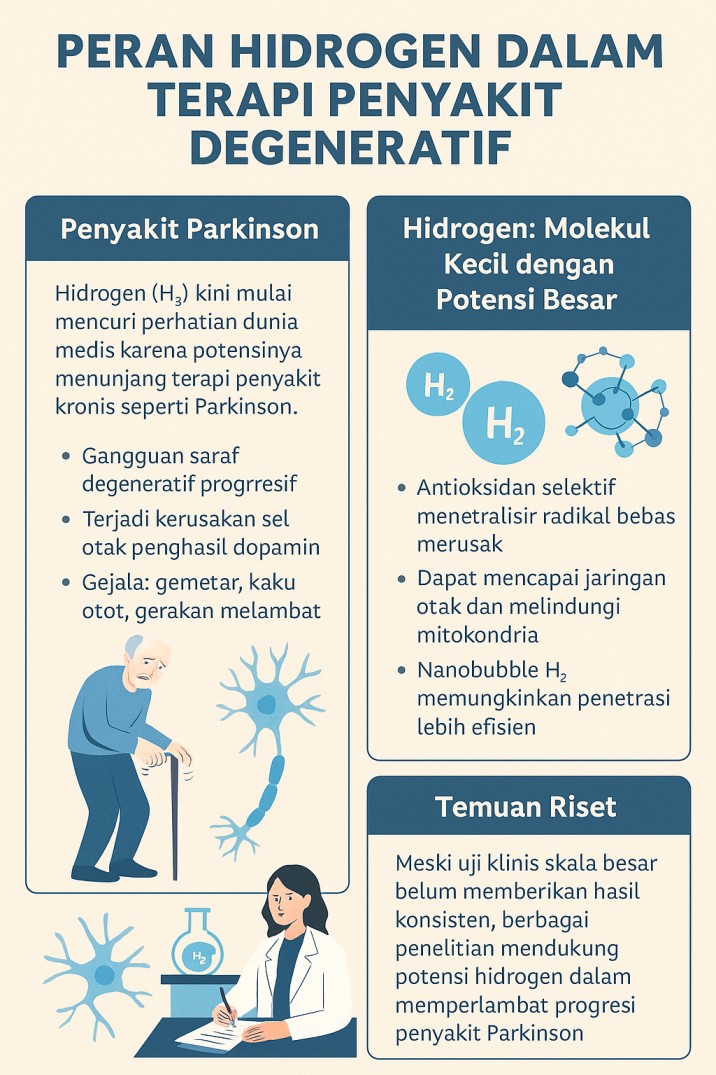
Hydrogen (H₂) is widely known as a lightweight gas commonly used for industrial and energy purposes. However, in recent years, this tiny molecule has begun to attract attention in the medical field due to its potential in supporting therapy for various chronic diseases. One such condition is Parkinson’s disease, a progressive neurodegenerative disorder marked by symptoms such as tremors, muscle stiffness, and slowed movements. Although no cure has been found for Parkinson’s yet, research suggests that hydrogen may play a role in helping to slow the progression of the disease.
Parkinson’s disease is a degenerative disorder of the nervous system that develops gradually and is characterized by the death of dopamine-producing brain cells—dopamine being a key chemical that helps regulate movement. As a result, patients experience symptoms such as tremors, muscle rigidity, and slowness of movement. According to the WHO, the number of Parkinson’s cases has doubled in the last 25 years. Experts have discovered that the disease is not only caused by a lack of dopamine, but also involves chronic brain inflammation (neuroinflammation), the buildup of free radicals (oxidative stress), and damage to mitochondria—the part of the cell that produces energy. These three factors worsen each other, gradually weakening and destroying nerve cells. Current medications can relieve symptoms but are not yet able to stop the underlying nerve damage.
Hydrogen: A Small Molecule with Great Potential
Hydrogen (H₂) is now being considered as a complementary therapy for degenerative diseases like Parkinson’s due to its unique properties as a selective antioxidant. This molecule can neutralize the most harmful free radicals without disrupting important biological processes, unlike some conventional antioxidants. Its very small size and neutral charge allow it to easily pass through cell membranes and reach brain tissues. Moreover, hydrogen has anti-inflammatory effects and is believed to protect mitochondria—our cells’ energy factories—from damage caused by oxidative stress. Recent innovations such as hydrogen nanobubbles enable the gas to be encapsulated in ultra-small, stable bubbles, allowing it to reach target tissues more effectively.
Various studies have supported hydrogen’s potential in the context of Parkinson’s. Animal research has shown that hydrogen-rich water can reduce dopamine neuron damage and decrease oxidative stress. Early clinical trials in humans have also shown improvements in motor symptoms following regular hydrogen water consumption, although larger-scale trials have not yet shown consistent results. In Indonesia, the Institute of Molecular Innovation (IMI), in collaboration with the University of Brawijaya Hospital, is developing nanobubble hydrogen therapy as a safe and promising approach to support brain function in Parkinson’s patients. While not a replacement for primary treatment, hydrogen offers new hope as a complementary therapy that may slow disease progression and improve patients’ quality of life.
Source:
Yoritaka A, Takanashi M, Hirayama M, Nakahara T, Ohta S, Hattori N. Pilot study of H2 therapy in Parkinson’s disease: A randomized double‐blind placebo‐controlled trial. Movement Disorders [Internet]. 2013 Feb 11;28(6):836–9. Available from: https://doi.org/10.1002/mds.25375
Fujita K, Seike T, Yutsudo N, Ohno M, Yamada H, Yamaguchi H, et al. Hydrogen in drinking water reduces dopaminergic neuronal loss in the 1-methyl-4-phenyl-1,2,3,6-tetrahydropyridine mouse model of Parkinson’s disease. PLoS ONE [Internet]. 2009 Sep 29;4(9):e7247. Available from: https://doi.org/10.1371/journal.pone.0007247