
Oxyhydrogen Nanobubbles: Tiny Bubbles with Extraordinary Stability
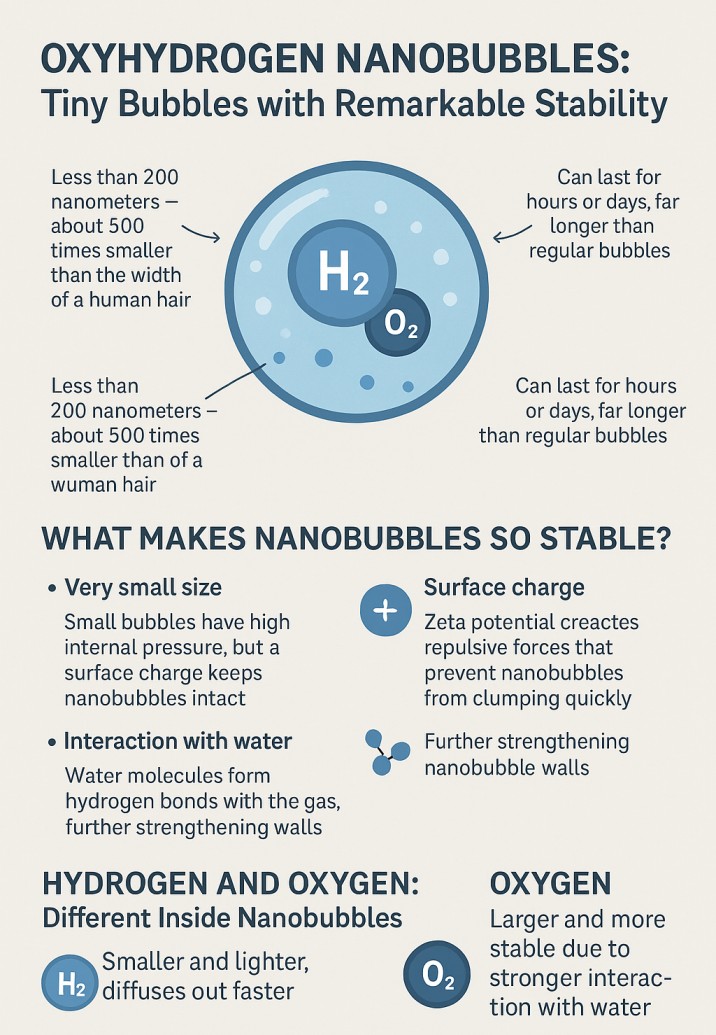
When we hear the word “bubble,” most of us think of soap bubbles that quickly burst. But there is a special kind of ultra-small bubble—called a nanobubble—that can last far longer than we might expect. Nanobubbles measure less than 200 nanometers, which means they are about 500 times smaller than the diameter of a human hair. One type that is now widely studied is the oxyhydrogen nanobubble, a combination of hydrogen gas (H₂) and oxygen gas (O₂) trapped inside water in the form of ultra-small bubbles. Interestingly, these bubbles show unusual stability—they can remain intact for hours or even days, unlike ordinary bubbles that survive only for seconds.
What Makes Nanobubbles So Stable?
Research from the Institut Molekul Indonesia explains that nanobubbles last longer than ordinary bubbles due to several key factors. First, their tiny size means that the internal pressure inside each bubble is extremely high. Normally, such pressure would cause a bubble to burst quickly. However, nanobubbles behave differently because of the presence of electric charges on their surface (called zeta potential). These charges cause the nanobubbles to repel one another, preventing them from merging or disappearing too quickly. In addition, the surrounding water molecules also play an important role. These molecules can form bonds with the gas inside the bubble, strengthening the bubble’s outer layer and making it more stable. The combination of high internal pressure, surface electric charges, and water-gas interactions allows nanobubbles to survive far longer than ordinary bubbles, which typically last only a few seconds.
Even though they share the same bubble, hydrogen and oxygen behave differently. Hydrogen is very small and light, which allows it to move more easily and escape the bubble more quickly. Oxygen, on the other hand, is larger and interacts more strongly with water, making it more stable inside the bubble. This contrast is fascinating because, when combined in the form of an oxyhydrogen nanobubble, the result is a unique system that is actually more stable than either gas alone. In other words, the combination of hydrogen and oxygen produces a tiny bubble that can store gas much longer than ordinary bubbles.
Why Does This Matter?
The unusual stability of oxyhydrogen nanobubbles opens up exciting opportunities in many fields. In medicine, their potential is especially compelling. Because nanobubbles are so small—about a hundred times smaller than a red blood cell—they can enter tissues that are otherwise difficult to reach. The hydrogen inside them acts as a powerful antioxidant, helping neutralize harmful free radicals, while the oxygen can improve oxygen supply to tissues that lack it. Furthermore, nanobubbles can serve as “vehicles” to deliver drugs directly to target cells, allowing for more precise treatment with fewer side effects. They can also enhance medical imaging, since their gas content makes them visible under ultrasound, helping doctors see organs more clearly.
What truly sets nanobubbles apart is their ability to last far longer than ordinary bubbles. While soap bubbles or soda bubbles survive only for seconds, nanobubbles can persist for hours or even days. This stability makes them not just a scientific curiosity, but also a promising technology for the future. With all their potential, oxyhydrogen nanobubbles may become an innovation that changes the way we tackle health challenges. These tiny bubbles show us that something very small can have a very big impact.
Source:
Hernowo, A. (2024). Stability and gas diffusion: A theoretical approach to evanescence and permanence in oxyhydrogen nanobubbles. Preprints, 20240902384. https://doi.org/10.20944/preprints202409.2384.v1