Nitrogen: From a “Neutral” Gas to a Mechanical Therapy for Blood Vessels Opening a New Paradigm in Microcirculatory Health
By: Mr. Kan Eddy
For more than a century, nitrogen has been regarded as a gas that “does nothing” inside the human body. We inhale it continuously—approximately 78% of the air entering our lungs is nitrogen—yet classical medical textbooks have treated it merely as a space filler, a simple diluent of oxygen. But what if this assumption is not entirely correct?
Interdisciplinary research combining fluid physics, vascular biology, and nanobubble technology is beginning to suggest that nitrogen may play a role not as an active chemical substance, but as a mechanical agent that operates physically within the vascular system. This emerging idea is being developed by Inovasi Molekuler Indonesia (IMI) in collaboration with the RAHO (Reverse Aging and Homeostasis Organization) research network.
For decades, modern medicine has largely viewed the human body as a chemical system. Most therapies are designed to influence biochemical reactions within cells, ranging from cholesterol-lowering drugs and signaling molecules such as nitric oxide that dilate blood vessels, to oxygen therapy that supports cellular metabolism. While this approach is undeniably important, it remains incomplete. The human body does not operate solely according to chemistry; it is also governed by the laws of physics. Blood flow, for example, is strongly influenced by mechanical factors such as vessel diameter, stiffness of the vessel wall, the presence of plaque and calcium deposits, and physical obstructions within the small vessels that form the microcirculation. In many chronic diseases—such as heart disease, stroke, diabetes, and degenerative disorders—the core problem is often not merely a chemical imbalance at the cellular level, but a physical blockage of blood flow pathways at the microvascular scale. This is where a mechanical approach becomes crucial, because without open flow channels, even the most effective biochemical signals and nutrients cannot function optimally.
Why Is Nitrogen Interesting from a Physical Perspective?
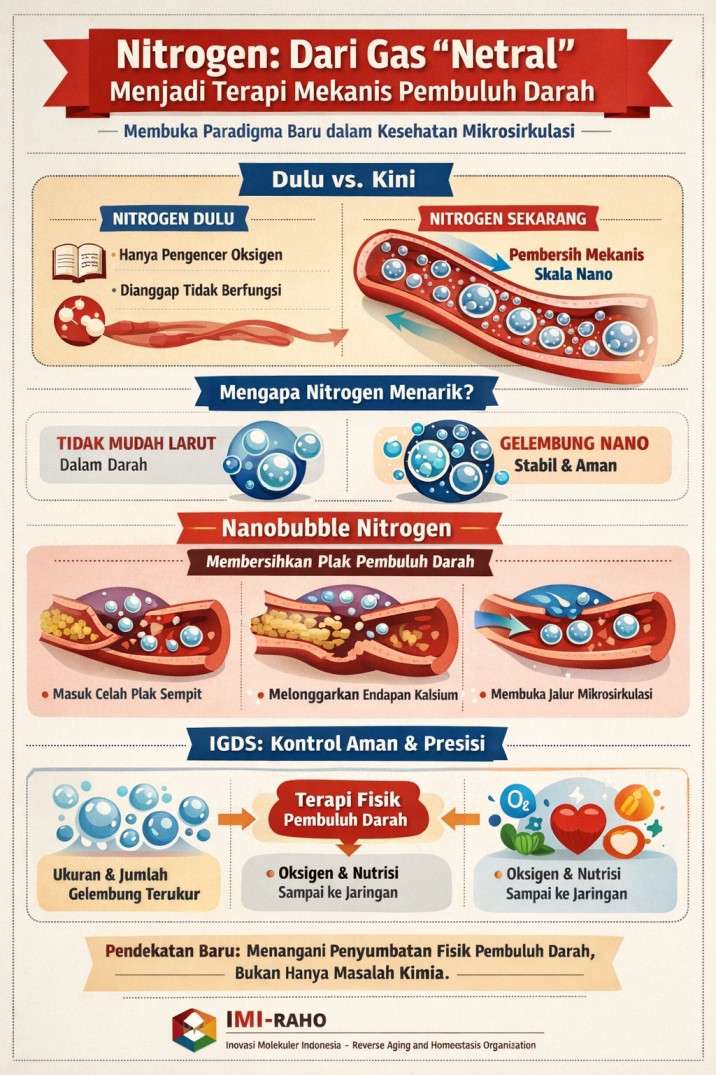
From a physical standpoint, nitrogen is intriguing because it possesses properties that distinguish it from other medical gases. Nitrogen is poorly soluble in blood, meaning it tends to remain in the gaseous phase rather than being rapidly absorbed like oxygen or carbon dioxide. In addition, nitrogen can be engineered into extremely small and stable gas bubbles known as nanobubbles—thousands of times smaller than red blood cells. At this scale, nitrogen bubbles can move along with blood flow without obstructing vessels. It is true that under uncontrolled conditions, such as during diving, nitrogen can cause health problems. However, the issue lies not in the nitrogen itself, but in the formation of large bubbles in excessive amounts. With modern technologies capable of precisely controlling bubble size and concentration, the very physical properties of nitrogen that were once considered dangerous can instead be harnessed safely and effectively for therapeutic purposes.
Nitrogen Nanobubbles: A Nanoscale Mechanical “Cleaner”
Plaques within blood vessels, especially those hardened by calcium deposits, have irregular and porous structures, characterized by narrow gaps and microscopic channels that are difficult for blood cells to pass through. Red blood cells measure approximately 7–8 micrometers in diameter, and when flow pathways become narrower than this, the delivery of oxygen and nutrients to tissues is compromised. This is where nitrogen nanobubbles demonstrate their advantage. With sizes of only a few hundred nanometers—far smaller than blood cells—nitrogen nanobubbles can penetrate microgaps within plaques and move along with the plasma component of blood. Under certain conditions, such as natural shear forces from blood flow or mild stimulation using low-intensity ultrasound, these nanobubbles can generate microcavitation—highly localized and controlled mechanical stress. This gentle mechanical action does not damage tissue but is sufficient to loosen calcium deposits, gradually fragment plaque structures, and reopen microcirculatory pathways. The process is not akin to an explosion, but rather resembles the slow removal of scale from within the vessel walls.
IGDS: The Key Technology for Safety and Precision
Historically, the presence of gas within blood vessels has been considered inherently dangerous—and this concern is justified when gas delivery is uncontrolled. To address this challenge, Inovasi Molekuler Indonesia (IMI) has developed the concept of an Intelligent Gas Delivery System (IGDS). This system enables precise control over nanobubble size, the number of bubbles per milliliter, and their gradual, evenly distributed delivery within the circulation. With this approach, therapeutic dosing is no longer measured in terms of gas mass, but in quantifiable and safe nanobubble populations. This distinction marks a fundamental difference between nitrogen bubbles that arise uncontrollably in decompression sickness and nitrogen nanobubbles used as biomechanical therapy.
Within this framework, nitrogen functions as a form of “vascular infrastructure therapy.” If oxygen provides energy to cells and nitric oxide regulates biological signaling, nitrogen operates at a more fundamental level by restoring the physical pathways of blood flow. Once microcirculation is reopened, oxygen and nutrients can once again reach tissues efficiently, allowing the body’s natural healing processes to resume. This approach encourages us to view disease not only as a chemical imbalance at the cellular level, but also as a physical obstruction within vascular structures. In this light, nitrogen—long regarded as a neutral and passive gas—emerges as an intelligent biomechanical tool that opens the way toward a new medical paradigm: a form of medicine grounded in structure and mechanics, complementing conventional biochemical approaches.